
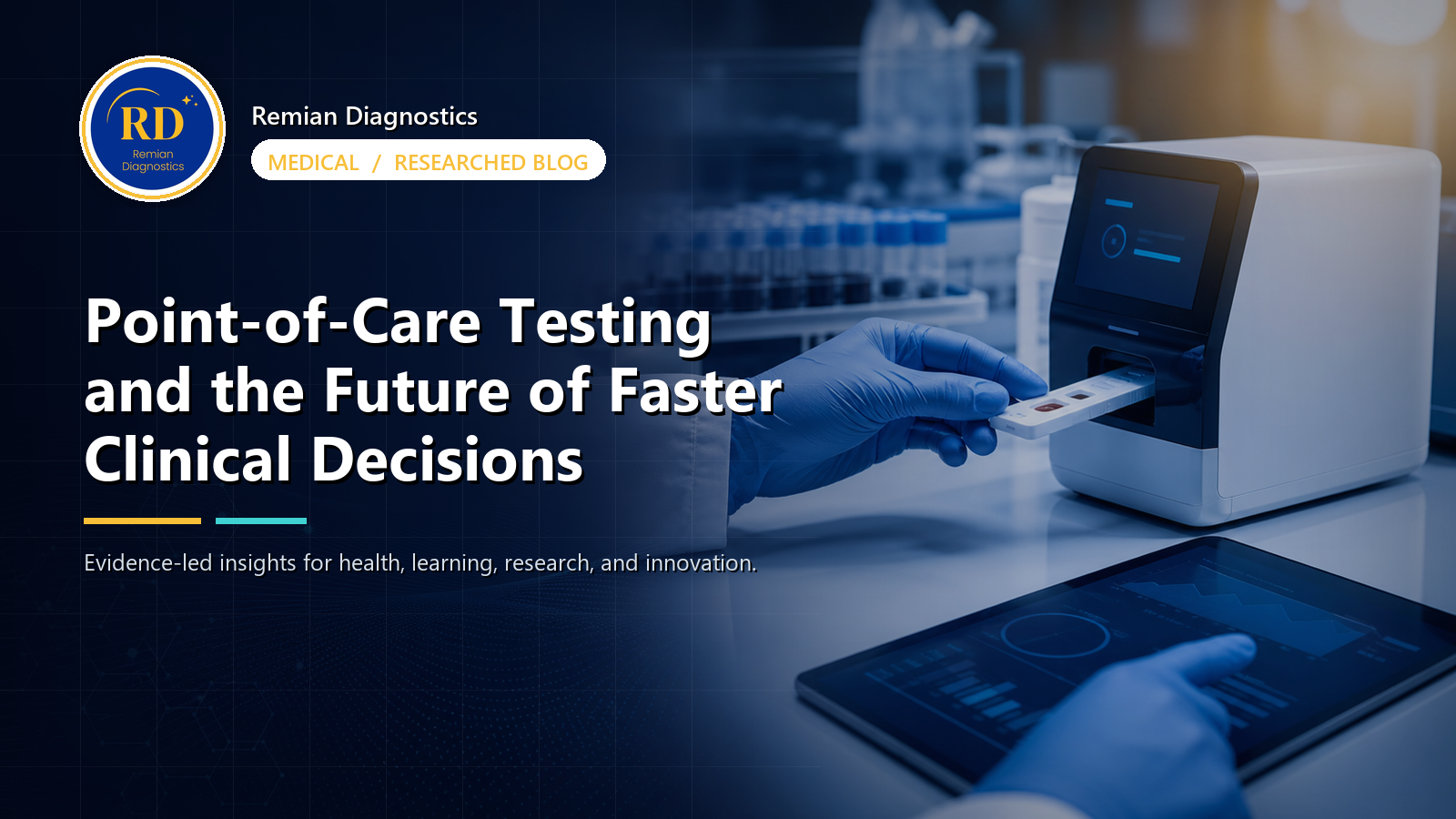
Point-of-care testing is changing how quickly clinicians can move from suspicion to action, especially where delayed laboratory turnaround can affect treatment decisions.
What point-of-care testing changes
Point-of-care testing brings selected diagnostic services closer to the patient. Instead of waiting for every sample to move through a central laboratory pathway, some tests can be performed near the clinic, ward, outreach site, or emergency setting. The aim is not to replace the laboratory, but to shorten the time between testing and decision-making.
This is especially valuable in urgent care, infectious disease management, maternal and child health, chronic disease monitoring, and remote settings. A faster result can guide treatment, reduce unnecessary prescriptions, support triage, and help teams decide when referral is needed.
Quality must lead the conversation
Speed alone is not enough. Point-of-care testing only improves care when quality assurance, staff competency, calibration, documentation, and result interpretation are handled properly. Without these safeguards, fast results can become fast mistakes.
Laboratory professionals therefore remain central. Their role expands from performing tests to designing quality systems, training users, monitoring external quality assessment, validating devices, and advising clinicians on interpretation. Good point-of-care testing is a partnership between clinical teams and laboratory governance.
AI and the next phase
New research is exploring how machine learning can improve point-of-care tools, especially in image analysis, signal interpretation, risk prediction, and decision support. These innovations may make testing more portable and easier to use, but they also raise questions about validation, bias, privacy, and accountability.
For health systems, the sensible path is balanced adoption. Start with the clinical problem, define the quality standard, train users, monitor performance, and only scale what produces reliable benefit. Faster testing should mean safer decisions, not weaker oversight.
Key takeaways
- Point-of-care testing can reduce delays between testing and treatment decisions.
- Quality assurance and laboratory oversight remain essential.
- AI-enabled diagnostic tools must be validated carefully before routine use.
Sources reviewed
This article is an original Remian Diagnostics educational post prepared from public, reputable sources. It is not copied from the linked references.